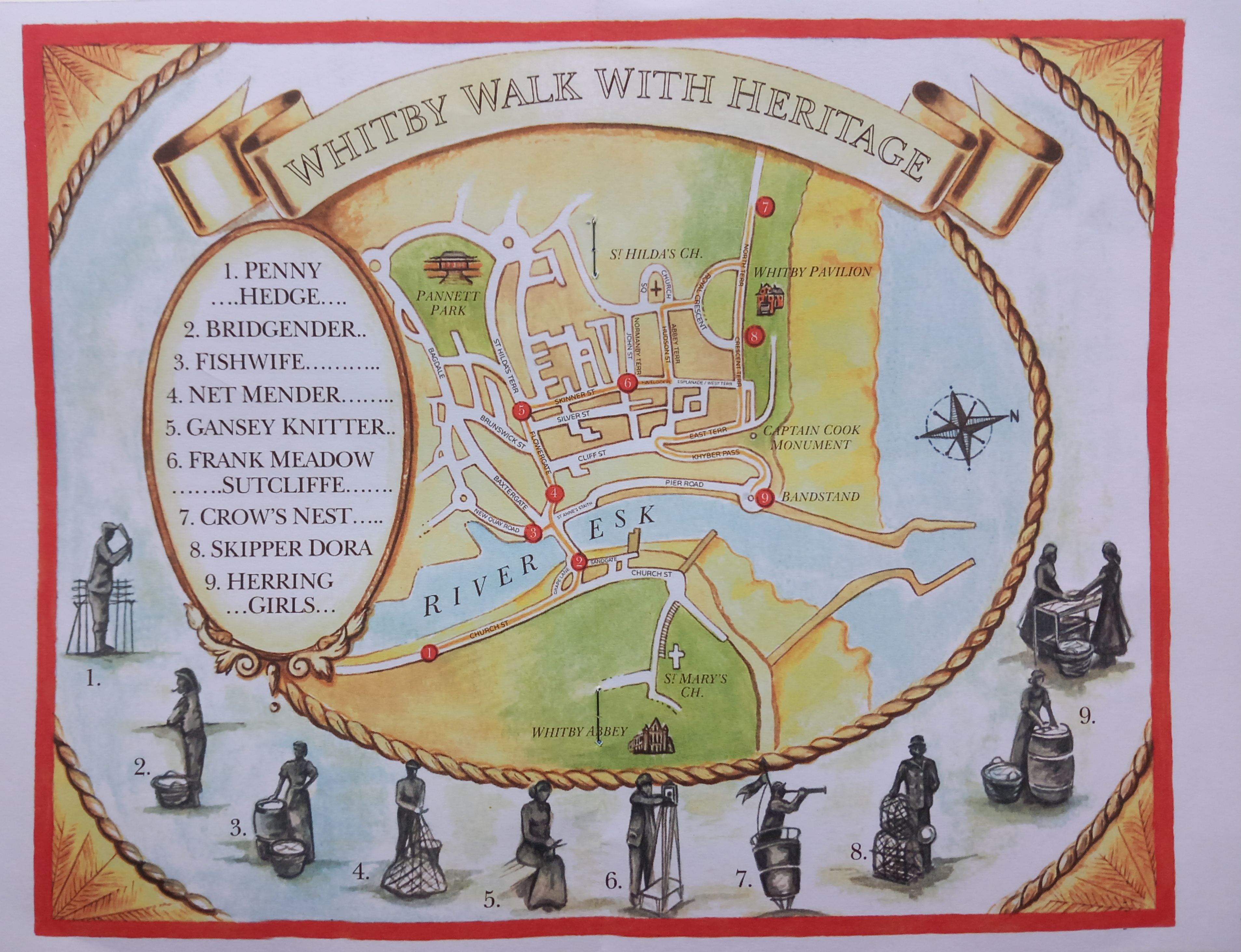
Whitby’s Walk with Heritage Trail
For me, one of the best things to do in Whitby is to follow Whitby’s Walk with Heritage Trail, which features nine stunning life-size sculptures by local artist Emma Stothard. She was inspired to create them by Whitby’s fishing heritage. Pick up a leaflet with a map from the tourist office in town, or download the Love Exploring Mobile App for free. Follow the trail and learn more about the history of Whitby and its fishing industry.

Who is Emma Stothard?
Emma Stothard is a sculptor who now lives in Whitby. She was born in Hull and later studied fine art at Southampton Solent University. She returned to Yorkshire to pursue a teaching career. While she was doing her PGCE in Wakefield, she was inspired by the works of Henry Moore and Elizabeth Frink displayed in the grounds of what is now the Yorkshire Sculpture Park. She began making small animals from woven willow.
In the years since, Emma’s work has attracted more and more interest, both here in the UK and internationally. She received a loan from the Prince’s Trust, which enabled her to become a full-time sculptor. Today, she works in metal as well as willow. Her sculptures grace the gardens of stately homes, galleries and private homes around the world.
The Walk with Heritage Trail in Whitby
In 2019, Scarborough Borough Council approached Emma about creating a series of sculptures, the aim being to encourage footfall to the quieter parts of Whitby. The last of these was unveiled in 2021.
Together, the nine pieces take visitors on a three-kilometre route around the town.
Each figure portrays a character with a powerful connection to the sea. They are carefully woven by hand and made from steel wire wrapped around a steel armature, then hot-dip galvanised. You can see the sculptures in any order you choose or follow the trail.
Penny Hedge
If you follow Whitby’s Walk with Heritage Trail as it is described in the official leaflet, this sculpture is the first one you will see. It is found opposite the Middle Earth Tavern on Church Street. It is a tribute to one of Whitby’s strangest legends – the Penny Hedge. The story goes that one autumn day in 1159, a group of noblemen were out hunting. Their hounds attacked a boar, which took shelter in a hermitage. The hermit closed the door on the dogs. The enraged hunters attacked the hermit, leaving him for dead. On his deathbed, he suggested that, instead of the death penalty for murder, they and their descendants should enact an annual penance – the construction of a woven ‘hedge’ from branches cut using only a knife ‘of a penny price’. The hedge needed to withstand three tides. If it didn’t, the lords would forfeit their lands.
The planting of the Penny Hedge continues to this day. Every year at 9am on the eve of Ascension Day, 39 days after Easter, the ritual takes place under the supervision of the Bailiff of the Manor of Fyling. When the hedge is planted, a horn is blown three times and “Out on ye, out on ye, out on ye!” is called out.

Bridgender
The next statue you will find on the Walk with Heritage Trail is the appropriately named Bridgender, located on the east side of Whitby’s famous swing bridge, up against the wall of Holland and Barrett. With his gansey and sou’wester, he’s based on a Sutcliffe photograph, which depicts a group of fishermen passing the time of day, sharing gossip and knowledge. These men were nicknamed ‘The University of Whitby’
Invariably, people are sitting on the bench next to Bridgender, so patience is required to get a photo without tourists in it!

Fishwife
Whitby’s Walk with Heritage Trail continues to the other side of the swing bridge, where you will see the Fishwife with her barrel of fish. Whitby’s women worked as hard as their husbands, who went to sea. As well as looking after the home and family, they baited the lines and sold the catch. It was a hard life, and life expectancy for these women was lower than the national average at the time.

Net Mender
When you climb the quaint but very steep Flowergate from the harbour, you will come across the Net Mender, the next sculpture on the Walk with Heritage Trail. When fishermen weren’t out on their boats, they would be mending their lines, pots, and nets by hand on the quayside. They congregated in groups to chat while they worked, relieving the boredom of this tedious task.

Gansey Knitter
I think this is my favourite of all the sculptures on Whitby’s Walk with Heritage Trail. As a crafter myself, I appreciate seeing other crafters being portrayed in artworks. She is hidden in plain sight, sitting on a low wall at the junction of Skinner Street and Flowergate. You could walk past her without even noticing her. It’s worth taking a moment, though, to think about the centuries of tradition she represents.
The Gansey jumper is one of the most practical garments in the history of hand-knitting. It is a hardwearing, distinctly patterned, seamless sweater worn by fishermen at sea. It is knitted from tightly spun worsted wool to create a weatherproof garment. In the past, each community had its own pattern, so that if a fisherman was lost at sea, his gansey would help identify him when the body was recovered.
The overall design hasn’t changed in hundreds of years. It is now sold as desirable casual wear in the chic boutiques in town, bought by people who have never even stepped foot on a boat.

Frank Meadow Sutcliffe
This sculpture is one of only two on the trail that represent a real individual. You will find it on the corner of Skinner Street and John Street. Frank Meadow Sutcliffe is depicted focusing his camera down the road where his studio used to be.
Frank was a very successful Victorian photographer. He was born in Whitby in 1853. In the early days of photography, he captured everyday life with never-before-seen artistry and skill. At the time, most of the imagery portraying Victorian life was either drawn or painted. Frank photographed the working lives of fishermen and farmers with stunning clarity. His images of herring girls and barefoot children made him famous throughout the world. One of his photographs inspired the Bridgender sculpture described above.

Crow’s Nest
On West Cliff, opposite the paddling pool, you will find the Crow’s Nest sculpture. This figure, with his telescope pointing out to sea, celebrates the invention of the crow’s nest by William Scoresby Senior, one of Whitby’s most successful whaling captains. The mast-top lookout provided shelter for the ship’s navigator.

Skipper Dora
Further along West Cliff, near the sunken garden, there is the only other sculpture on Whitby’s Walk with Heritage Trail that represents a real person. Dora Walker (1890 to 1980), also known as ‘Skipper Dora’, was a remarkable woman. She was born to a wealthy family in West Yorkshire and attended the elite Roedean College for Girls. She worked as a nurse during World War 1. Later, she suffered from bronchial problems and moved to Whitby on medical advice. She bought a boat, the Good Faith, and went to sea, becoming the first female fishing boat skipper on the North Sea Coast. During the Second World War, Dora qualified as a sea pilot and guided boats through the minefields laid in the North Sea. She was the only woman captain to hold her licence throughout the war. In later life, she became an author, writing her memoirs and stories about the fishing community in Whitby.

Herring Girls
You will find the final, and probably most evocative, sculpture on Whitby’s Walk with Heritage Trail just behind the bandstand on the harbour wall. The Herring Girls represents the young women who, in the late 18th and early 19th centuries, followed the herring fishing fleet along this coast. They travelled by train, ready whenever the boats came in, to gut and pack the fish. They were tough, independent women. Most of them came from Scotland. They worked in teams of three. Usually, an older, experienced woman kept an eye on two younger girls, some of them barely in their teens. Two of the team would gut the herrings as a third packed them into barrels.
Local families in Whitby looked forward to the arrival of the herring fleet. They would provide lodgings in their cottages for the girls. Lasting friendships were formed as workers returned to the same lodgings year after year.

Click here to read my full article about the best things to do in Whitby
Whitby’s Walk with Heritage Trail on Local News
Watch this video to see how the creation of the trail was reported on local news.
If you're travelling soon, please use these links!
Are you travelling soon? Use these links when making your bookings. These are the companies we use. It won't cost you any extra, but we will earn a few pennies to help keep Happy Days Travel Blog going. Thank you!!
Make sure you take out travel insurance. If you are a digital nomad or long-term traveller, try the specialist provider SafetyWing. (Never leave home without protecting yourself, your trip and your belongings!)
Book your flight with Skyscanner
Book your accommodation with Booking.com
Book a tour with Tour Radar
Book city tours and activities with Viator or Get Your Guide
Check out my Resources Page for more companies we recommend.
Disclosure: This post contains affiliate links. If you click through for more information or to make a purchase, it may result in a small commission coming my way. Please note that there is no extra cost to you associated with this. Thank you so much for supporting my site.
