A Walking Tour of Panaji: Stories, Sweets, and Slow Discovery
Panaji — formerly known as Panjim, and still called that by everyone I spoke to — is the capital of Goa and home to around 114,000 people. It’s a city that many visitors pass through on their way to the beaches, but one that quietly rewards those who take the time to walk its streets.
Rather than trying to piece things together on my own, I joined a guided walking tour — something I often find is the best way to understand a place beyond first impressions.
A Short History of Panaji
Panaji hasn’t always been Goa’s capital. Under Portuguese rule, that role belonged to Old Goa (Velha Goa), which flourished as a major colonial and religious centre from the 16th century. However, repeated outbreaks of disease led to its decline, and in the mid-1800s, the administrative capital shifted to Panaji, then a small riverside settlement.
The city grew steadily under Portuguese influence, developing wide avenues, churches, public buildings, and residential quarters that still define its character today. When Goa became part of India in 1961, Panaji remained the capital and evolved into the state’s administrative and cultural heart.
Today, Panaji feels more lived-in and local than many parts of Goa. Government offices, schools, markets, neighbourhood cafés, and old family homes sit side by side, giving the city a quietly authentic rhythm.

Meeting Our Guide and Setting Off
At the appointed time, I walked to Panaji’s main post office to meet our guide, Divya. From the outset, her storytelling brought the city to life, grounding what we were about to see in its layered history and everyday realities.
From there, we set off on foot — the only way, really, to appreciate Panaji properly.
Fontainhas: Goa’s Latin Quarter
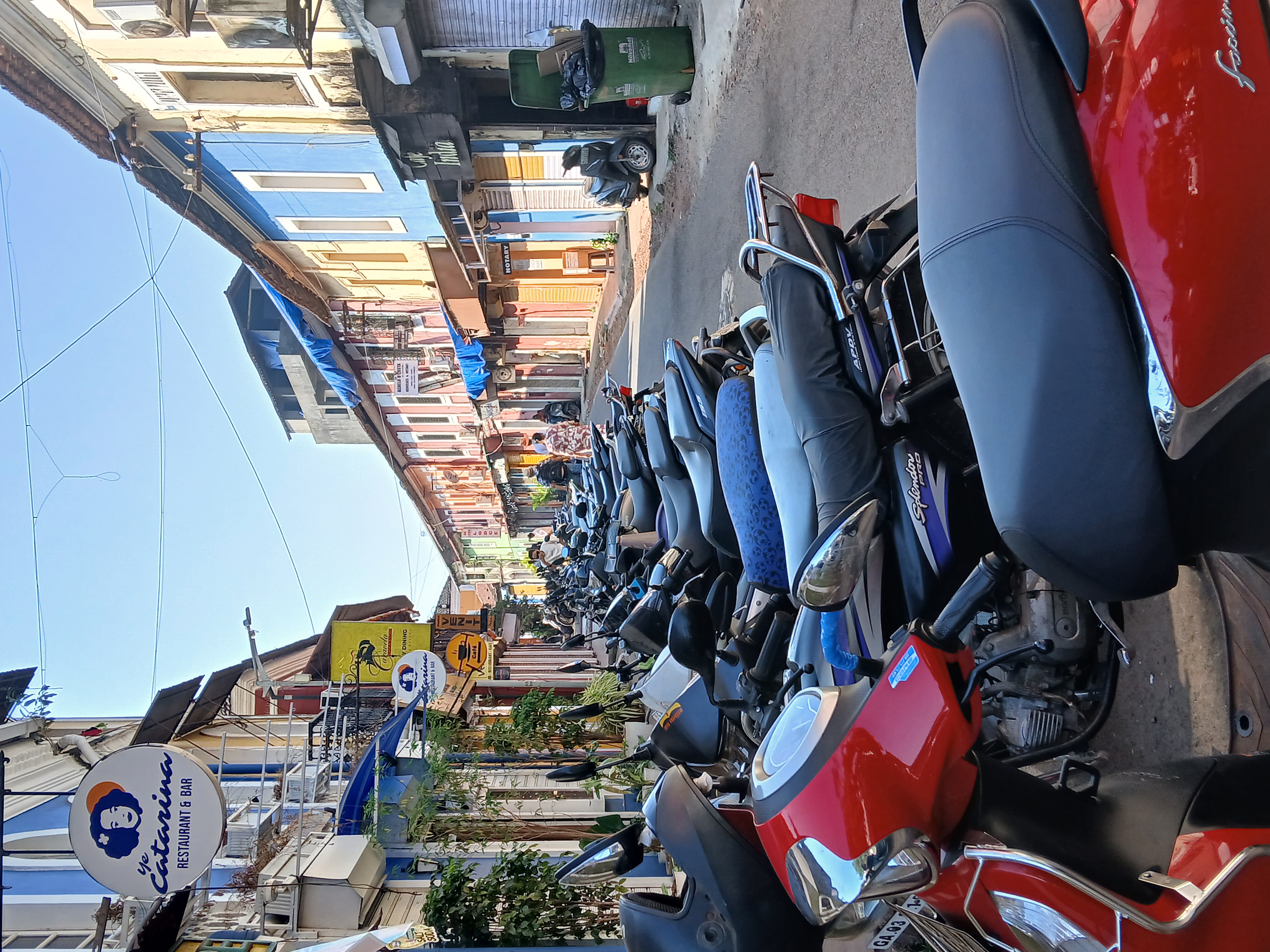
Our walk took us through Fontainhas, Panaji’s Latin Quarter and one of its most visually striking neighbourhoods. Narrow lanes wind between brightly painted houses in yellows, blues, greens, and terracottas — a legacy of Portuguese building traditions and colour regulations that once dictated how homes could be painted.
The area is undeniably picturesque, but it’s also very much residential. In many streets, photography was banned, which initially puzzled me — until I saw groups of Indian tourists posing in front of people’s front doors, leaning into open windows, and completely blocking the narrow roads. Most were ignoring the “No Photography” signs entirely. Seeing this made it very easy to understand why residents might feel frustrated.
One fascinating detail Divya pointed out was the use of mother-of-pearl in old windowpanes. When these houses were built, glass was prohibitively expensive, so this shimmering alternative was used instead — a beautiful and practical solution that also filtered the light and preserved privacy.

Sugar, Tiles, and Christmas Sweets
About halfway through the walk, we stopped at Confeitaria 31 de Janeiro, a charming old bakery decorated with flowers and colourful tiled tables. It was, unsurprisingly, a magnet for Instagram — the perfect photo opportunity for all the Grammers.
Inside, we sat down to taste three traditional Goan Christmas sweets:
Doce (pronounced dosh), made from chickpeas
Perad, a firm guava jelly
Bebinca, a layered dessert made primarily from egg yolks
The dominant flavour of all three was sugar. Lots of it. I’ll be honest — I wasn’t especially fond of any of them! 😂 Still, it was interesting to taste such an important part of Goan festive tradition.
Outside the bakery, I watched an artist carefully pencilling guidelines onto a cup before hand-signwriting it. When we passed by again about an hour later, the piece was completely finished. Watching that quiet concentration and skill unfold in real time was one of my favourite moments of the walk.

Craftsmanship in Everyday Life
Further along, we came across a craftsman recaning a chair — an incredibly skilled and time-consuming process. Even Divya paused to admire the work, explaining that chair caning is very much a dying art in Goa. Moments like this reminded me how much traditional knowledge survives quietly in everyday streets, often unnoticed unless you slow down.

Music, Memories, and a Ukulele
Our next stop was Balcao Café, where we had a drink — once again, something extremely sugary, so I limited myself to a sip — and listened to local musician Maxie Miranda.
Maxie played the ukulele and sang Over the Rainbow, White Christmas, and Yesterday, before sharing the story of how he met George Harrison when he visited Goa in 1992. Apparently, they played music together.
I was impressed.
Divya… less so.
Born in 1998, she had never even heard of The Beatles. 😂
It was one of those moments where generations gently collide — and where travel stories unexpectedly drift into personal memory.
The Church That Watches Over the City
Our final stop was the Church of Our Lady of the Immaculate Conception, one of Panaji’s most recognisable landmarks. Sitting proudly above the city, its white façade and zigzagging staircase dominate the skyline.
Sadly, the church was closed, so we couldn’t go inside, but even from the outside it felt significant — a visual reminder of Panaji’s colonial past and its enduring religious traditions.

Why Panaji Is Best Explored on Foot
This walking tour confirmed something I’ve felt many times before: cities like Panaji reveal themselves slowly. Through small details. Through stories. Through moments you’d never notice from a scooter or taxi window.
Panjim — Panaji — isn’t loud or showy. It doesn’t try to impress. But if you’re willing to wander, listen, and pause, it offers a rich, textured understanding of Goa beyond its beaches.
And sometimes, that’s exactly the kind of travel experience I’m looking for.
Watch this Video for More About Panaji
If you're travelling soon, please use these links!
Are you travelling soon? Use these links when making your bookings. These are the companies we use. It won't cost you any extra, but we will earn a few pennies to help keep Happy Days Travel Blog going. Thank you!!
Make sure you take out travel insurance. If you are a digital nomad or long-term traveller, try the specialist provider SafetyWing. (Never leave home without protecting yourself, your trip and your belongings!)
Book your flight with Skyscanner
Book your accommodation with Booking.com
Book a tour with Tour Radar
Book city tours and activities with Viator or Get Your Guide
Check out my Resources Page for more companies we recommend.
Disclosure: This post contains affiliate links. If you click through for more information or to make a purchase, it may result in a small commission coming my way. Please note that there is no extra cost to you associated with this. Thank you so much for supporting my site.
