Walking Through History: A Guided Heritage Walk in Old Goa
There are places where history feels loud and crowded — and then there are places where it unfolds slowly, best experienced on foot, with a good guide and plenty of pauses. A walking tour of Old Goa falls very much into the second category.
I joined a heritage walk run by Make it Happen and led by Yashasvi, whose passion for Goa’s layered past shaped the entire experience, turning stone arches and quiet courtyards into stories of empire, faith, power, and everyday life.

A Brief Introduction to Old Goa
Once the capital of Portuguese India, Old Goa was one of the most important cities in Asia during the 16th and 17th centuries, known then as Goa Dourada — Golden Goa. A centre of trade, religion, and learning, it rivalled major European cities in wealth and influence before disease, changing trade routes, and political shifts led to its gradual abandonment. Today, Old Goa holds a very different kind of significance within the state of Goa: not as a living capital, but as a place of memory. Its monumental churches, convents, and open spaces stand as quiet witnesses to a complex past, making it one of the most historically important — and contemplative — places to visit in Goa.
The Viceroy’s Arch and the Arrival of Empire
Our walk began at the Viceroy's Arch, where Yashasvi set the scene with an overview of Portuguese colonisation in Goa. Built in 1599 by Governor Francisco da Gama, the arch commemorates the Portuguese conquest of the city by his great-grandfather, Vasco da Gama, a century earlier.
One side of the arch features a stone statue of Vasco da Gama himself, while the other shows St Catherine, a pairing that perfectly symbolises the entwining of imperial ambition and religion. The arch was completely restored in 1954. It also marks the long history of the viceroys, a role that remained in place until 1961, when Goa finally gained independence from Portuguese rule.

From there, we walked down to the Mandovi River, watching ferries glide back and forth to Divar Island, a reminder that even today, water remains central to daily life here.

A Palace That No Longer Exists
Retracing our steps, we stopped at the Gate of the Palace of Adil Shah. Once a magnificent structure, it later became the residence of Portuguese governors until 1695, and was used for grand festivities until its demolition in 1820.
All that survives now is the outer gate — built from basalt and decorated with Hindu religious imagery — a striking and poignant reminder of how layers of culture often outlast the buildings themselves.

Church of St Cajetan: Baroque Grandeur in Goa
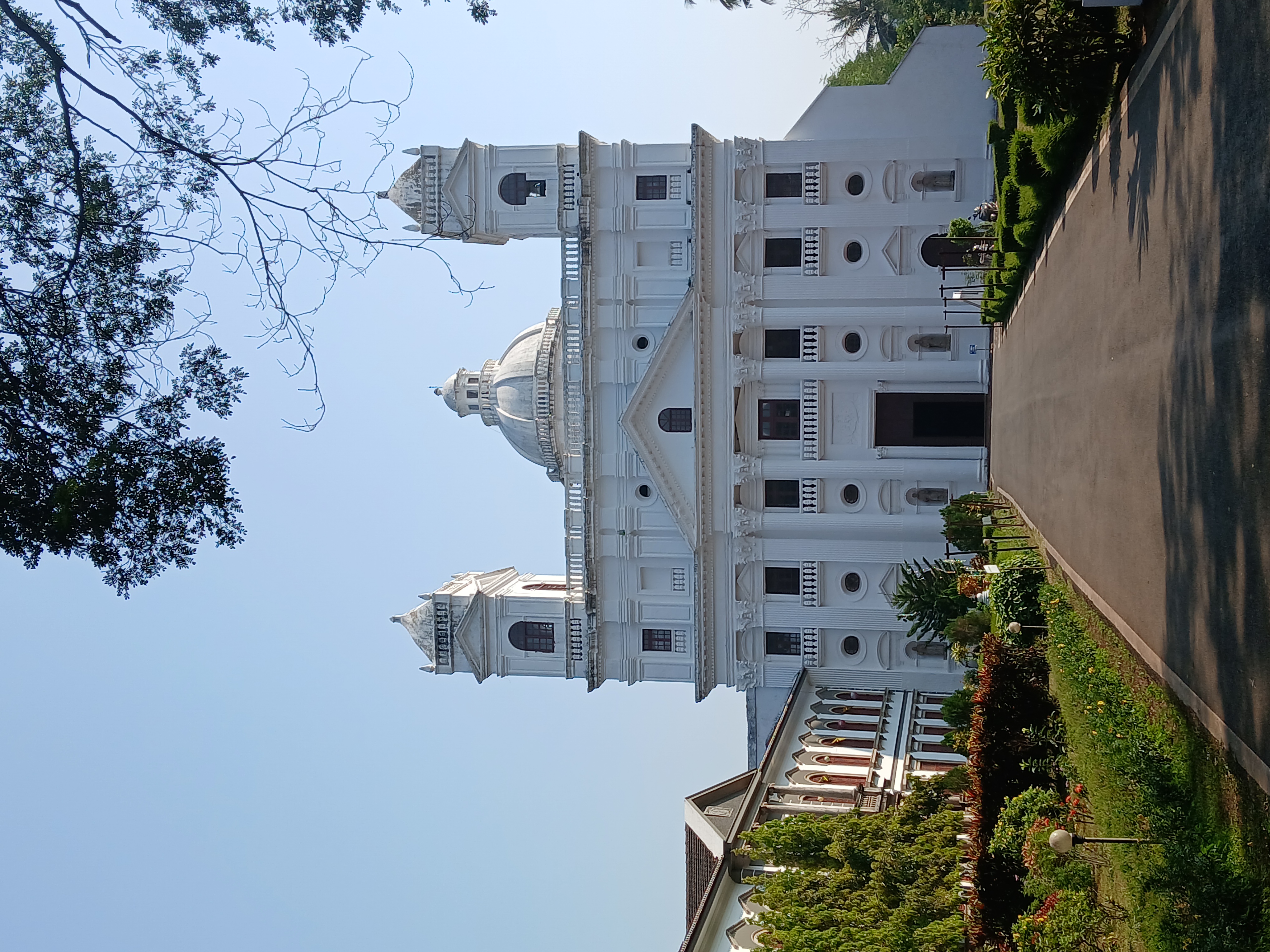
One of my favourite stops was the Church of St Cajetan, designed by an Italian architect and built by local artisans in the second half of the 17th century. Modelled on St Peter’s Basilica in Rome, it features India’s first church dome of its kind.

Inside, the church contains seven richly gilded Baroque altars, with the main altar dedicated to Our Lady of Divine Providence. Yashasvi somehow managed to take an extraordinary photograph with my phone of the dome’s interior using a timer and what I can only describe as camera wizardry — I remain completely clueless as to how she did it 😂.

Sé Cathedral: Scale, Silence, and Strangeness
Next came Se Cathedral, the largest church in Old Goa and, when built in the early 17th century, the largest in all of Asia. Constructed on a raised laterite plinth, its exterior is Tuscan in style, while the interior follows the Corinthian order.
The cathedral looks slightly unbalanced today: the tower on the right-hand side collapsed after being struck by lightning and was never replaced. Inside, the main altar — dedicated to St Catherine of Alexandria — features a richly gilded panel depicting her martyrdom.

Outside, I was surprised to see what I think were the first transgender toilets I’ve ever encountered, alongside a striking modern sculpture near the well. It shows a prostitute, weighed down by the faces of the men who abused her, speaking to Jesus, who tells her she will be absolved of her sins if she drinks from the well. I couldn’t help wondering what happens to the men.

Museums, Chapels, and Shafts of Light
Adjoining the cathedral is the convent that now houses the Archaeological Museum of Old Goa and the Church of St Francis of Assisi. Built in 1661 from laterite blocks and lime-plastered, it reflects the tradition of painting all Old Goa’s churches white as a symbol of purity.
Inside, a highly decorative Baroque altar shows St Francis of Assisi embracing Jesus on the cross — sadly, no photos allowed.
We also visited St Catherine's Chapel, memorable for the shaft of sunlight illuminating its interior. Outside, an impressive stepwell hinted at architectural styles I’m told will become even more elaborate once I reach Rajasthan.

Basilica of Bom Jesus: Pilgrimage and Presence
Our final stop was the Basilica of Bom Jesus, a Jesuit church built between 1594 and 1605. Simple in style, its white paint has been removed to reveal the original stonework.

The basilica houses the remarkably preserved body of St Francis Xavier, displayed in a silver casket with glass sides and top. Once accessible to pilgrims, the casket is now raised high after years of touching and kissing caused damage. No photos are allowed inside — and somehow that feels right.
Outside, a family insisted on having their photo taken with me. The child looked distinctly unimpressed 😂.

Ending the Walk Slowly
We finished the walk sitting together while Yashasvi completed her fascinating overview of Goa’s history. She was an excellent guide — knowledgeable, thoughtful, and deeply passionate about her subject — and the perfect companion for a place that deserves to be experienced slowly.
Old Goa isn’t just about churches or colonial history. It’s about noticing what remains, what’s missing, and how stories linger quietly in the spaces between.
Watch this Video for Further Old Goa Insights
If you're travelling soon, please use these links!
Are you travelling soon? Use these links when making your bookings. These are the companies we use. It won't cost you any extra, but we will earn a few pennies to help keep Happy Days Travel Blog going. Thank you!!
Make sure you take out travel insurance. If you are a digital nomad or long-term traveller, try the specialist provider SafetyWing. (Never leave home without protecting yourself, your trip and your belongings!)
Book your flight with Skyscanner
Book your accommodation with Booking.com
Book a tour with Tour Radar
Book city tours and activities with Viator or Get Your Guide
Check out my Resources Page for more companies we recommend.
Disclosure: This post contains affiliate links. If you click through for more information or to make a purchase, it may result in a small commission coming my way. Please note that there is no extra cost to you associated with this. Thank you so much for supporting my site.
