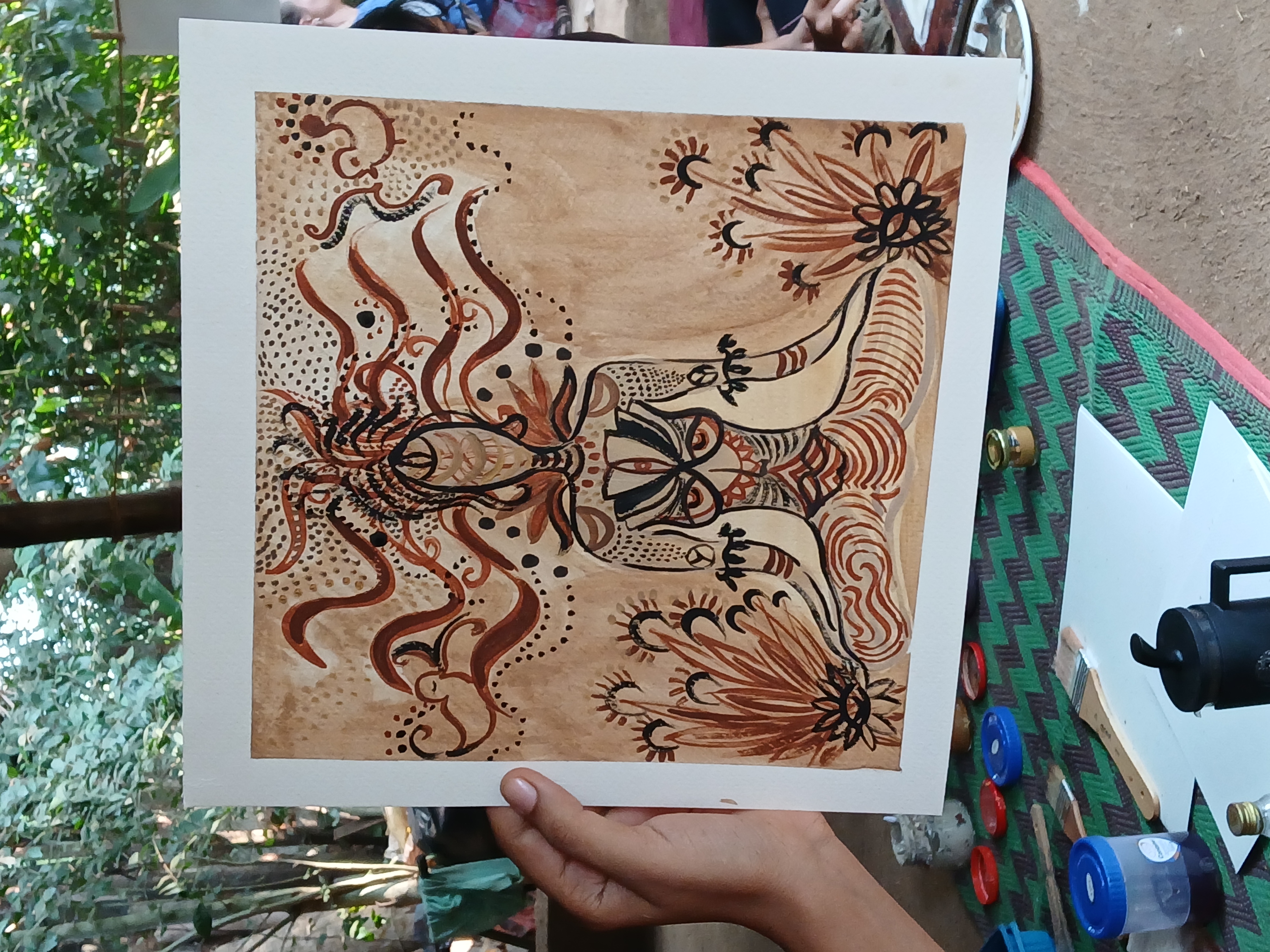
Colours of Earth: Making Paint from Soil and Stone in Goa
While I was in Goa, I booked myself and my friend Neha onto an all-day Colours of Earth workshop at Mati Earth – the same creative space where I’d done a cyanotype printing workshop the week before.
Despite living in Goa for four years and being an artist herself, Neha didn’t even know Mati Earth existed. That alone says something about how quietly special the place is.
There were nine of us taking part, and our tutor for the day, Aastha, began by gently laying out what the workshop would involve. By the end of the day, we would understand how to extract natural pigments from soil and rock, turn those pigments into watercolour paint, and then use the paints we’d made ourselves to create artwork.
It sounded simple enough. It wasn’t. And that was exactly what made it so absorbing.
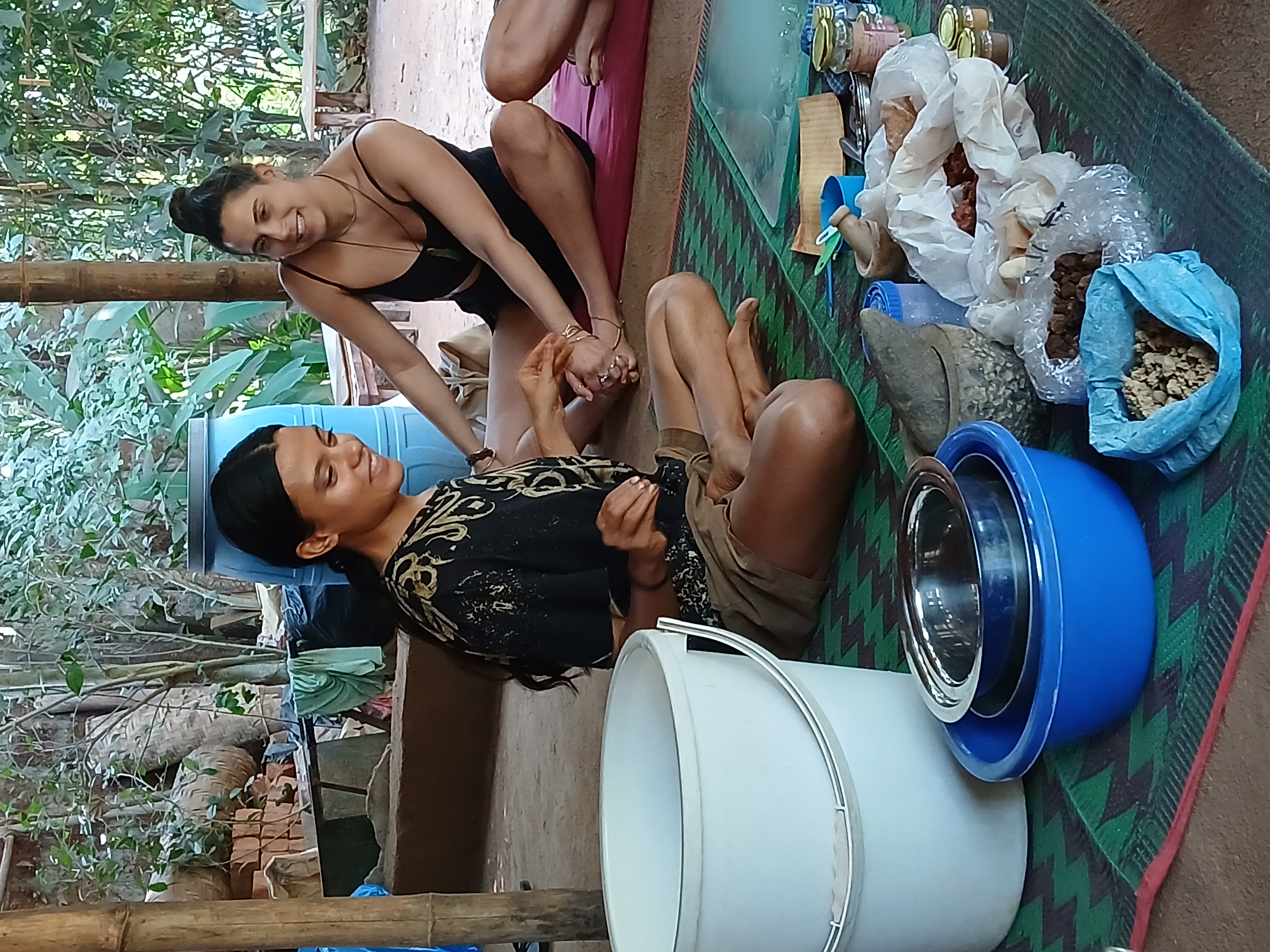
Extracting colour from the land
The morning session was devoted entirely to pigment making. Before you can make paint, you have to understand what soil actually is.
All soils and rocks are made up of sand, silt, and clay. The colour lives in the clay. So the task, whether you’re working with soil or rock, is to separate the clay from everything else.
For soils, that means washing. For rocks, it starts with brute force.
We crushed rocks down to powder using a pestle and mortar, then washed both the powdered rock and the soil samples in bowls of water. After swirling the mixture and letting it rest briefly, the contents began to separate naturally: sand sinking to the bottom, silt settling above it, clay suspended near the top, and clear water floating above all of that.

The trick, Aastha explained, is patience and gentleness. Swirl, count to five, then carefully pour off the water containing the clay, leaving the sand and silt behind. This process can take minutes or days, depending on the material. Eventually, once the clay has settled, the excess water is poured off, and the clay is left to dry completely – ideally on a flat surface in the sun.

What struck me most was how elemental the process felt. No chemicals. No shortcuts. Just gravity, water, time, and attention.
Riverbeds, we learned, are ideal places for foraging clay-rich soils. In Goa, areas around Sweet Lake in Arambol are particularly good. Once dried, earth pigment clay keeps indefinitely. It can be stored in chunks or ground into powder, by hand or even in a blender. In cooler climates, a food dehydrator or very low oven can help with drying – though this only works for earth pigments, not plant dyes, which change colour with heat.
From pigment to paint
Pigment on its own is just coloured dust. To turn it into paint, you need a binder – and the binder you choose determines the type of paint you end up with.
Watercolour, gouache, oil paint, tempera… they all start with pigment, but rely on different binders. If a binder has its own colour, it will affect the final shade of the paint.
For watercolours, we made a traditional binder using gum arabic, a natural tree resin. The recipe was wonderfully precise and reassuringly old-fashioned:
70g gum arabic
1½ cups boiling water
35g honey, glycerin, or a mix of both (to act as a humectant and retain moisture)
A few drops of clove oil as a preservative
The gum arabic is dissolved in boiling water, the honey or glycerin is stirred in, and the whole mixture is filtered through muslin to purify it. The thickness can be adjusted depending on whether you want a transparent watercolour wash or something closer to gouache.

Once binder and pigment are ready, the final step is mulling – combining equal quantities of dried pigment and binder on a glass or marble surface, using a palette knife and a muller (or even a smooth pebble). Every single pigment particle needs to be coated. As you mull, water slowly evaporates, and the paint thickens, becoming smooth and luminous.

By the end of the morning, we had jars of paint made from nothing more than soil, stone, water, resin, and patience. The range of colours we achieved was astonishing.
Lunch, then letting go
We broke for a delicious vegetarian lunch – one of those meals that feels nourishing in every sense – before settling down for the afternoon painting session.

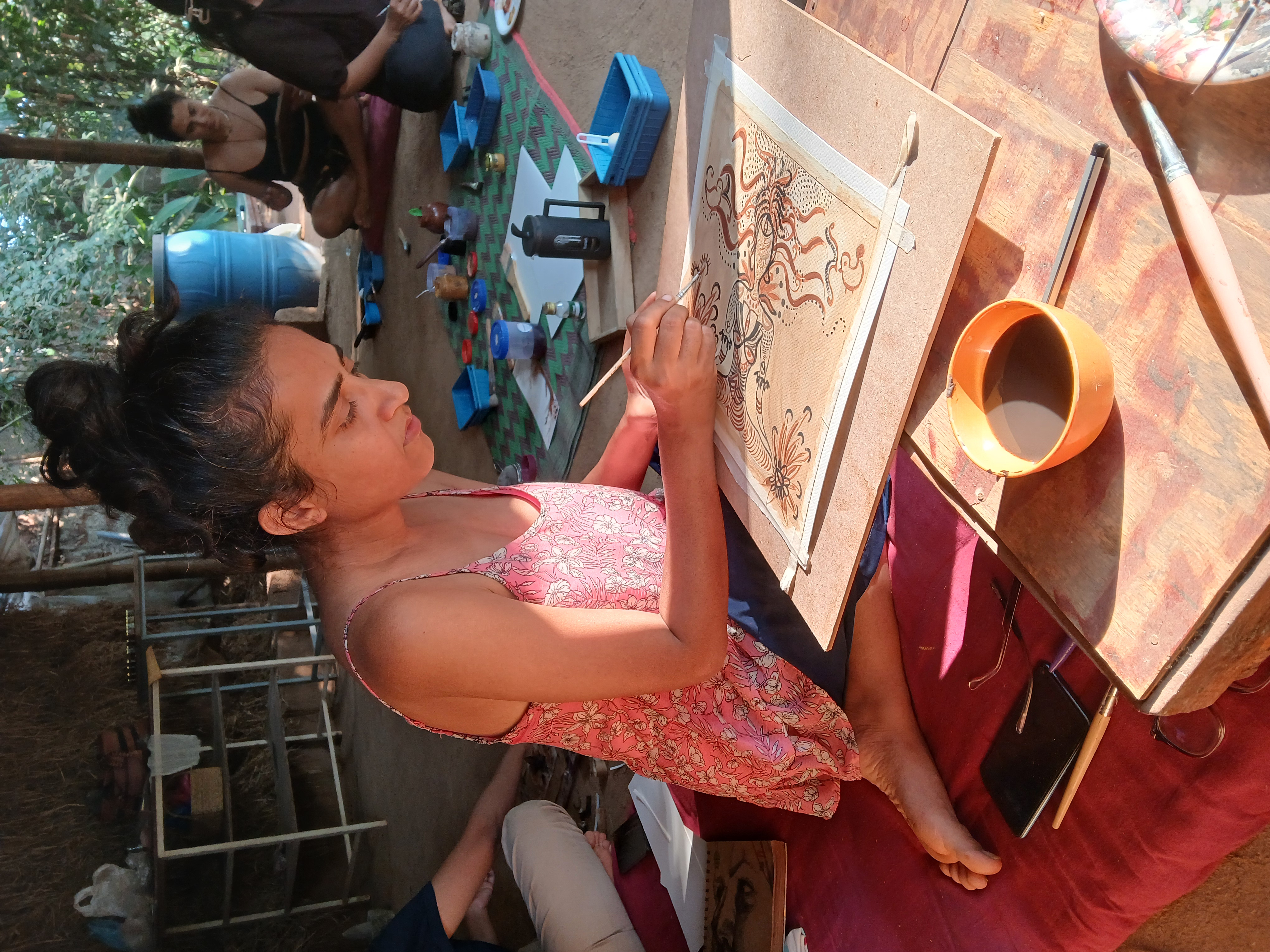
I should say upfront: I am not an artist. My “painting” ended up more like a doodle, vaguely reminiscent of a patchwork of fabric pieces. But I loved the process. There’s something deeply satisfying about using paint you’ve made yourself. Every brushstroke carries the memory of the morning’s work.

Neha, on the other hand, created a beautiful painting, and it was a joy to see how differently everyone responded to the same materials. The space was filled with quiet concentration, occasional laughter, and that lovely, creative hum that only seems to happen when people slow down together.
A very old practice, still alive today
Working with earth pigments is not a new or niche technique. It’s one of the oldest artistic practices in the world.
Natural pigments made from ochres, iron oxides, and clay have been used for tens of thousands of years – from prehistoric cave paintings to ancient Egyptian tombs, from Roman frescoes to Indian temple murals. Across India in particular, earth pigments have long been used in wall paintings, ritual art, manuscript illustration, and traditional crafts.
What I’ve noticed while visiting museums and historic sites here is how often these colours appear: warm reds, soft yellows, muted browns, smoky greys. Seeing the process behind them made those museum visits suddenly feel more intimate. These weren’t abstract “art materials” – they were earth, gathered locally, prepared by hand, and transformed slowly.
Today, earth pigments are still used by traditional artisans, natural builders, conservators restoring historic artworks, and contemporary artists drawn to sustainable, place-based practices. Workshops like this one don’t just teach a technique; they reconnect you to a lineage of making that spans cultures and centuries.
Why this workshop stayed with me
What I loved most about the Colours of Earth workshop was how completely it anchored creativity to place. The colours came from the land around us. The process demanded time and attention. Nothing was rushed.
In a world of ready-made art supplies and instant results, spending a whole day just to make your own paint felt quietly radical. It reminded me that creativity doesn’t always begin with expression. Sometimes it begins with listening – to materials, to place, and to processes that have been around far longer than we have.

If you go: Colours of Earth Workshop in Goa
Where: Mati Earth, Mandrem, Goa
Length: Full day (morning pigment extraction, lunch, afternoon painting)
Who it’s for: Anyone curious about natural colour and process – no art experience needed
What you’ll do:
Forage, wash, and extract pigments from soil and rock
Make your own watercolour paint using natural binders
Use the paints you’ve made to create artwork
What’s included: All materials and a vegetarian lunch
What to bring: Comfortable clothes you don’t mind getting dusty, curiosity, and patience
Good to know: This is a slow, hands-on workshop – more about learning and process than producing a “perfect” finished piece
Watch this Video to Learn More
If you’re travelling soon, please use these links!
Are you travelling soon? Use these links when making your bookings. These are the companies we use. It won’t cost you any extra, but we will earn a few pennies to help keep Happy Days Travel Blog going. Thank you!!
Make sure you take out travel insurance. If you are a digital nomad or long-term traveller, try the specialist provider SafetyWing. (Never leave home without protecting yourself, your trip and your belongings!)
Book your flight with Skyscanner
Book your accommodation with Booking.com
Book a tour with Tour Radar
Book city tours and activities with Viator or Get Your Guide
Check out our Resource Page for more companies we recommend.
Disclosure: This post contains affiliate links. If you click through for more information, or to make a purchase, it may result in a small commission coming my way. Please note that there is no extra cost to you associated with this. Thank you so much for supporting my site.
