Wetting New Sand: A Visit to the Museum of Goa
Some places don’t just show you art — they invite you to think differently, to listen more closely, and to notice the stories already unfolding around you. My recent visit to the Museum of Goa (MOG) was very much one of those experiences.

The museum is a contemporary art space conceived in 2015 by Goan artist Subodh Kerkar, who transformed his existing studio into a public art institution with the help of renowned architect Dean D'Cruz. At a time when Goa lacked dedicated cultural spaces for contemporary art, Kerkar imagined a place that would democratise art, making it accessible, relevant, and rooted in Goan life rather than confined to white walls and hushed reverence.
The first thing I did on entering the museum was sit down to watch a short film narrated by Dr Kerkar himself. In it, he explains the thinking behind the space and introduces some of the works on display. He also shares a story his father told him when he was a child — a story that stayed with me long after I’d left.
He spoke about watching waves roll onto a beach. Most waves, he said, only wet sand that has already been wet before. But every now and then, a larger wave reaches further up the shore, touching new, dry sand. His message was simple and profound: it’s important to wet new sand, and to witness new sand being wet.
I loved this sentiment. It felt like both an artistic philosophy and a gentle nudge towards curiosity, courage, and creative risk.
Art, History, and Everyday Life
As I began to wander through the museum, one of the first works to catch my eye was Chillies by Subodh Kerkar himself. No other imported commodity has shaped Indian life quite like the chilli. Before the Portuguese brought chillies to Goa from South America in the early 16th century, local food was flavoured mainly with pepper and other spices. Today, it’s almost impossible to imagine Indian cuisine without them.
In this installation, chilli sculptures are clad in Indian textiles, symbolising their gradual Indianisation. India is now the world’s largest producer and consumer of chillies, with the average person eating around 543 grams of dried chilli each year. The country even exports chillies back to South America — a full-circle journey rendered here in fabric, colour, and form.

Another striking work by Kerkar is Goa’s Ark, inspired by a lesser-told chapter of Goan history. When the Portuguese colonised Goa, many Hindu temples were destroyed and churches built in their place. To protect their deities, Hindu communities transported sacred icons by canoe to areas beyond Portuguese control, such as Ponda in South Goa. That’s why, even today, many of Goa’s temples are found inland.
In the biblical story, God saves mankind through Noah’s Ark. In Goa, Kerkar suggests, mankind saved God. Hence the name — Goa’s Ark. It’s a powerful reminder of resilience, adaptation, and the coexistence of faiths that characterise Goa today.
Festivals, Fire, and First Encounters with Art
One of the most visually impressive pieces in the museum is a 22-foot-tall model of Narakasur, a figure central to Goa’s Divali celebrations. In the days leading up to the festival, communities come together to build towering effigies of Narakasur. On the night before Divali, the streets fill with music, dancing, and fire as the figures are ceremonially burned. When the flames die down, Divali begins — light overcoming darkness, and a new cycle of hope unfolding.
For many Goan children, this is their first experience of art: learning to sculpt, paint, engineer, and collaborate. Over time, Narakasur figures have evolved. In North Goa, they are often muscular and fearsome, while in the south, they appear rounder and more human. The museum’s Narakasur is a collaborative piece that brings these two traditions together — the stance of the north combined with the body of the south.

Threads, Bread, Flowers, and Shared Tables
One of my favourite works in the museum is the Crochet Christmas Tree, created by The Crochet Collective. Crochet and Christmas both arrived in Goa with the Portuguese and have since become woven into everyday life. Christmas is communal and celebratory; crochet, by contrast, has traditionally been a solitary craft practised quietly by women.
This project brought 25 women together to plan, stitch, and create collectively. Conversations began around colours and stitches, and gradually a community formed — one built on shared stories, laughter, and mutual support. The result is something far greater than any one person could have made alone.

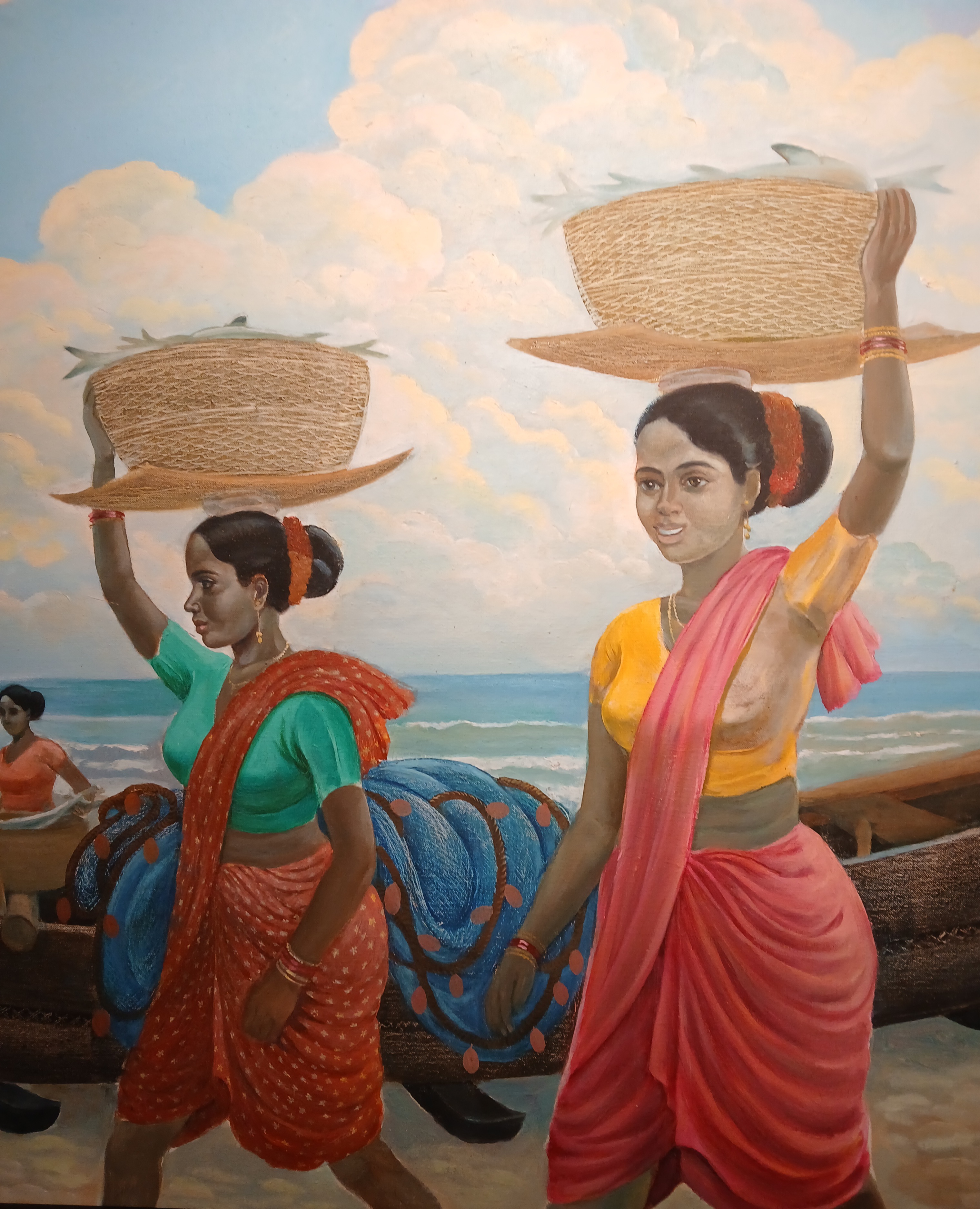
Nearby, I learned more about C. S. Kerkar (1924–2006), Subodh Kerkar’s father and a renowned Goan artist in his own right. Many of his works depict fishing and fish markets that are central to Goa’s cultural identity. He once said that “the state of Goa without fish is like the state of fish without water,” a line that feels both poetic and painfully relevant.

Bread, too, has its place here. Pao by Pradeep Naik celebrates the importance of bread in Goan life. While much of India traditionally ate chapattis, the Portuguese introduced yeast-based bread. Today, poders deliver fresh loaves by bicycle twice a day, announcing themselves with a distinctive horn. I’m getting used to that sound being my morning alarm 😊.

Plants, Petals, and Festival Foods
Another eye-catching installation is Matoli, the ceremonial canopy created during Ganesh Chaturthi and held above Lord Ganesha. Traditionally made with seasonal fruits, grains, vegetables, and forest plants, matolis are deeply ecological and collaborative, assembled just days before the festival, so everything remains fresh.
The museum’s version is a record-breaking collaborative work made from dried and preserved edible, non-edible, and medicinal plants — the largest and longest-lasting Matoli ever created in India.
In Fhatiyo, artist Chaitali Morajkar reflects on flowers not as symbols of romance, but as everyday companions in women’s lives — offerings at shrines, hair adornments, gifts between neighbours. They start conversations and quietly remind us that beauty often lives in habit and care.

Mhammai Zatra by Savia Viegas is a mixed-media work on khadi, celebrating Goa’s many religious festivals and pilgrimage fairs. With lace, embroidery, and patchwork, it honours the way food brings people together across communities. Sweets like Kaddio Boddo cross religious boundaries — what the goddess eats, the people eat too.

Stories That Stay With You
The final piece I want to mention is Rooster by Subodh Kerkar, an 11-foot-tall sculpture made from fibreglass and rubber tyres. It references the Portuguese Barcelos Rooster folktale — a symbol of justice and faith seen all over Goa.

Placed in the museum’s sculpture garden, the rooster is surrounded by what looks, at first glance, like a flowering hedge. Only when you look closer do you realise it’s entirely made from painted, recycled plastic bottles. The effect is unexpected and quietly stunning.

I’ve visited many contemporary art museums in cities around the world, but the Museum of Goa stands out as one of the best I’ve ever experienced. What makes it so special is not just the work itself, but the stories that accompany every piece. The Goan tradition of storytelling runs through the entire space — fascinating, layered, and deeply human.
After my visit, I spent some time in the museum shop, coming away with several books about Goan life. I’m looking forward to reading them slowly, filling in the many gaps in my understanding and, perhaps, wetting a little more new sand along the way.
Watch this Video to Learn More About MOG
If you're travelling soon, please use these links!
Are you travelling soon? Use these links when making your bookings. These are the companies we use. It won't cost you any extra, but we will earn a few pennies to help keep Happy Days Travel Blog going. Thank you!!
Make sure you take out travel insurance. If you are a digital nomad or long-term traveller, try the specialist provider SafetyWing. (Never leave home without protecting yourself, your trip and your belongings!)
Book your flight with Skyscanner
Book your accommodation with Booking.com
Book a tour with Tour Radar
Book city tours and activities with Viator or Get Your Guide
Check out my Resources Page for more companies we recommend.
Disclosure: This post contains affiliate links. If you click through for more information or to make a purchase, it may result in a small commission coming my way. Please note that there is no extra cost to you associated with this. Thank you so much for supporting my site.
