
Visiting Dharavi: Walking Through One of Mumbai’s Most Misunderstood Neighbourhoods
I was in Mumbai for a few days as part of my current trip around India, and one experience I knew I wanted to have — however uncomfortable it might feel — was a visit to Dharavi.
What is Dharavi?
Dharavi is often described as Asia’s largest slum. It is home to an estimated two million people and covers just 2.2 square kilometres – roughly half the size of New York’s Central Park. By any measure, it is one of the most densely populated places on earth.
A place shaped by history and migration
Dharavi began to take shape in the 1890s during the British Raj and has continued to grow ever since, as people have migrated to Mumbai from rural areas in search of work and opportunity. Today, it is home to an extraordinary mix of communities: local Maharashtrians, Nepalis, Chinese families, and people from almost every Indian state.
Muslims, Hindus, Christians, and Buddhists live alongside one another, largely in communal harmony – though, as you might expect when so many people live in such close proximity, tensions do arise. Still, what struck me most was not division, but coexistence.
Not just a place to live, but a place to work
Despite extreme overcrowding, limited waste management, zero privacy, and poor sanitation, Dharavi is far from a place of inactivity. In fact, it is a major informal economic hub, generating an estimated US$1 billion annually.
Thousands of tiny, single-room factories and businesses operate here, producing leather goods, textiles, pottery, and recycled plastics for both local and global markets. Life and work are deeply intertwined.
Water runs only from communal outdoor taps between 5pm and 7pm each day. Toilet facilities are limited and shared. And yet, the community functions with an efficiency and resilience that is hard to fully comprehend until you see it for yourself.

My Visit to Dharavi
Before my visit
It wasn’t my first encounter with what’s often referred to as poverty tourism. I’ve visited Soweto in South Africa before, and that experience stayed with me long after I left. Even so, I felt wary. Curious, yes — but also uneasy. That uneasiness felt important to acknowledge rather than ignore.
For me, one thing was non-negotiable: if I was going to visit Dharavi, I wanted to be guided by someone who actually lived there. Someone with lived experience, not an outsider narrating someone else’s reality. I made sure that was the case when I booked my tour through GetYourGuide.
Before we entered the slum, I spoke openly to my guide, Subhan, about my concerns. He listened, reassured me, and explained how the visit would work.
First impressions: density, muted colour, constant activity
The first thing that struck me wasn’t shock so much as sheer density. The number of people living and working in such close proximity is hard to comprehend until you’re standing in the middle of it.
What also surprised me was the lack of colour. Compared to many other places in India, Dharavi felt visually muted. Every square inch of space was filled with rubbish, raw materials, finished products, and everything was coated in layers of dust, dirt, pollution, earth, and grime. Whatever colour had once been there felt dulled, absorbed into the environment.
Industries at the heart of Dharavi
We visited the industrial areas first. People work in extremely cramped, hot conditions, often in dark, poorly ventilated rooms. Many live directly above the workshops where they work.
Some spaces were particularly difficult to be in: fabric dyeing workshops, tanneries, and soap-making factories. They were dirty, dim, and heavy with strong smells. This wasn’t something curated or softened for visitors — it was simply everyday life.

Homes, alleyways, and everyday encounters
Families in the slum often live in single rooms no larger than about two and a half metres by two and a half metres. My guide, Subhan, was born and raised in Dharavi and still lives there with his parents and two younger sisters in a tiny shared space. As he spoke about his life, it became clear how limited his options are.
To rent even the smallest shared room elsewhere would cost between 7,000 and 8,000 rupees a month (£56–£64). While that might not sound like much, the average wage in the slum is around 400 rupees a day (£3.20). Escape, in any meaningful sense, feels almost impossible.
As Subhan led me through narrow, dark alleyways – hot, airless spaces where many residents never see direct daylight – I tried to imagine what it must be like to live in such conditions for an entire lifetime.
I couldn’t.

And yet, everywhere I went, people were friendly. Curious. Happy to talk.
At one street stall, I was offered chapati with a sweet filling — essentially sugar with food colouring. The man serving it refused to take any money. He handed it to me, wrapped in newspaper, just as he did for the locals. I shared it with Subhan (I’m not supposed to have sugar anyway), and the stallholders seemed genuinely pleased — both that I shared it and that I wiped my hands on the newspaper afterwards, as is the local way.
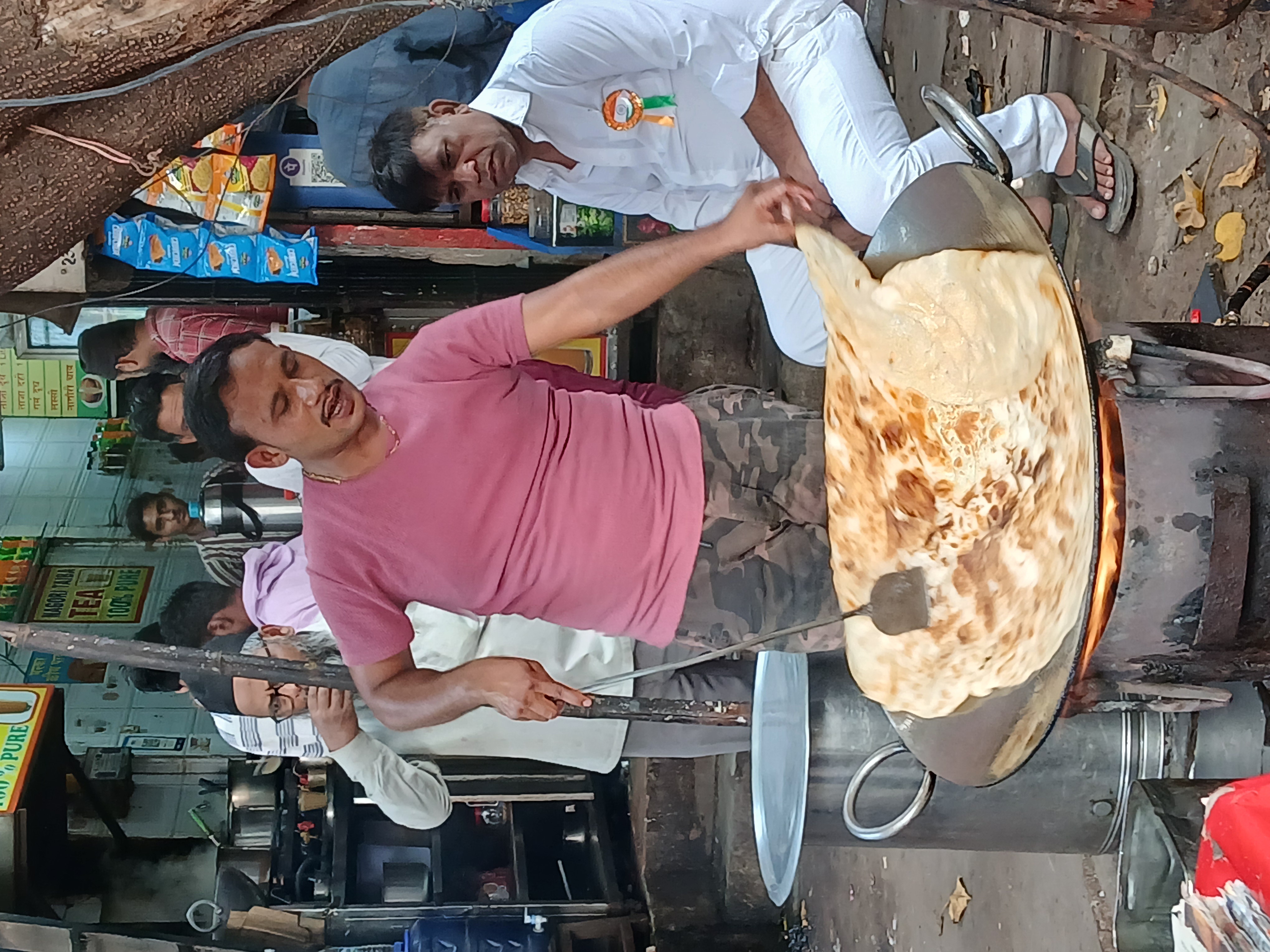
Republic Day celebrations inside the slum
It happened to be Republic Day in India, and there was music playing as we walked. At one point, we stopped to watch schoolchildren performing a dance in a very small, cramped space. A crowd gathered around — people laughing, filming, enjoying the moment. It felt joyful, communal, and completely unselfconscious.
A quieter way to visit
On this particular tour, I was the only visitor. That felt like a gift. Other groups were moving through the slum at the same time, and it was clear how easily groups can get in the way.
Being just me and Subhan meant we could move more naturally, stop when something caught my attention, and not feel like a spectacle ourselves. We spent around two and a half hours in Dharavi, stopping frequently to observe everyday life — including the parts that aren’t easy to see.
The realities that are hard to ignore
We saw raw sewage flowing directly into the canal that separates two parts of the slum. In that same canal, plastic collectors waded in, retrieving waste that would be taken to recycling centres and turned into usable products.
As we walked, Subhan constantly guided me — where to step, where to avoid. He explained that during the monsoon season, the alleyways flood completely. You can’t simply walk through them; you have to jump from step to step.
He also told me clearly when I could and couldn’t take photos. Photography in residential areas, especially inside people’s homes, was not acceptable. That boundary felt important — and reassuring.

Comfort, laughter, and unexpected moments
Throughout the visit, I felt comfortable. There was a lot of laughter.
At one point, we turned into an alley only to realise a wedding was taking place, blocking our path. We doubled back, took another route, and somehow emerged at the same wedding again. Navigating around it took time, but every time we encountered the wedding guests, they laughed with us. It was all good-spirited, human, and oddly joyful.
Dharavi and Slumdog Millionaire
Dharavi is perhaps best known internationally as the setting for Slumdog Millionaire. Knowing I was visiting, I rewatched the film beforehand. During the tour, Subhan pointed out several filming locations.
He explained that director Danny Boyle filmed only essential scenes inside Dharavi itself, moving in and out quickly. Many slum residents, Subhan told me, dislike the film. They feel it focuses almost entirely on violence and crime, which they argue is no more prevalent here than in many other parts of the world.
What struck me most was learning that no local residents benefited financially from the film. Any money paid went to state authorities and business owners, none of whom live in Dharavi.

Language, money, and respect
One thing Subhan mentioned that stayed with me was language. He referred to himself as “your local from the slum” and seemed comfortable using that term. My advice would be to take your cue from your guide and avoid imposing language you think sounds more acceptable.
I would also strongly advise against giving money to individuals. Nobody asked for any. There was no begging. And there’s no need to buy anything — the shops in Dharavi exist to meet local needs, not tourist demand.
An uncertain future
Dharavi’s future is under threat, with large-scale redevelopment plans underway. Subhan spoke openly about his fears — for himself, his family, and his community. Where will people go? Who will benefit? Who will be displaced?
There are no simple answers.
Leaving Dharavi — and what stayed with me
At the end of the tour, I called an Uber back to Colaba. Subhan turned and disappeared into the warren of alleyways that make up Dharavi, returning to a life that felt worlds away from my own — despite being only a few kilometres apart.
That contrast stayed with me long after I left.
Visiting Dharavi raised difficult questions about curiosity, responsibility, privilege, and intent — questions I’m still sitting with. In my next post, I’ll explore those questions more deeply, looking at slum tourism and poverty tourism more broadly: the arguments for and against, the ethical grey areas, and whether this is something we should be doing at all.
If you go to Dharavi, please follow these pointers:
If you’re considering a visit:
Go with a local guide who actually lives in the community. This isn’t optional — it’s essential.
Choose an ethical operator (I booked via GetYourGuide, filtering specifically for locally led tours).
Expect to feel uncomfortable at times. That discomfort is part of the experience — don’t rush to smooth it away.
While you’re there:
Follow your guide’s lead at all times - where to walk, where to stand, what to avoid.
Ask before taking photos and accept that many areas, especially residential ones, are off-limits.
Dress simply and respectfully - nothing flashy or attention-grabbing.
Wear closed shoes - no sandals or flip-flops, so you don't need to worry about what you're treading in.
Don’t give money or gifts. Nobody asked for any, and it can do more harm than good.
Only buy things you need (water or snacks, for example) - shops serve local needs, not tourism.
Listen more than you speak. This isn’t a place to perform empathy.
Afterwards:
Reflect before you post on social media.
Avoid sensational language or images.
Ask yourself: Who does my storytelling benefit?
Watch Gabi's Video to See More About Doing a Dharavi Tour
If you’re travelling soon, please use these links!
Are you travelling soon? Use these links when making your bookings. These are the companies we use. It won’t cost you any extra, but we will earn a few pennies to help keep Happy Days Travel Blog going. Thank you!!
Make sure you take out travel insurance. If you are a digital nomad or long-term traveller, try the specialist provider SafetyWing. (Never leave home without protecting yourself, your trip and your belongings!)
Book your flight with Skyscanner
Book your accommodation with Booking.com
Book a tour with Tour Radar
Book city tours and activities with Viator or Get Your Guide
Check out our Resource Page for more companies we recommend.
Disclosure: This post contains affiliate links. If you click through for more information, or to make a purchase, it may result in a small commission coming my way. Please note that there is no extra cost to you associated with this. Thank you so much for supporting my site.
